

Congress Should Subpoena the Programs That Chased the Soviet UFO Design
Whistleblowers say the U.S. government holds intact craft of non-human origin. The Pentagon says it holds no such hardware. Neither claim can be tested by asking where the craft are. It can be tested by asking which programs tried to build the components.
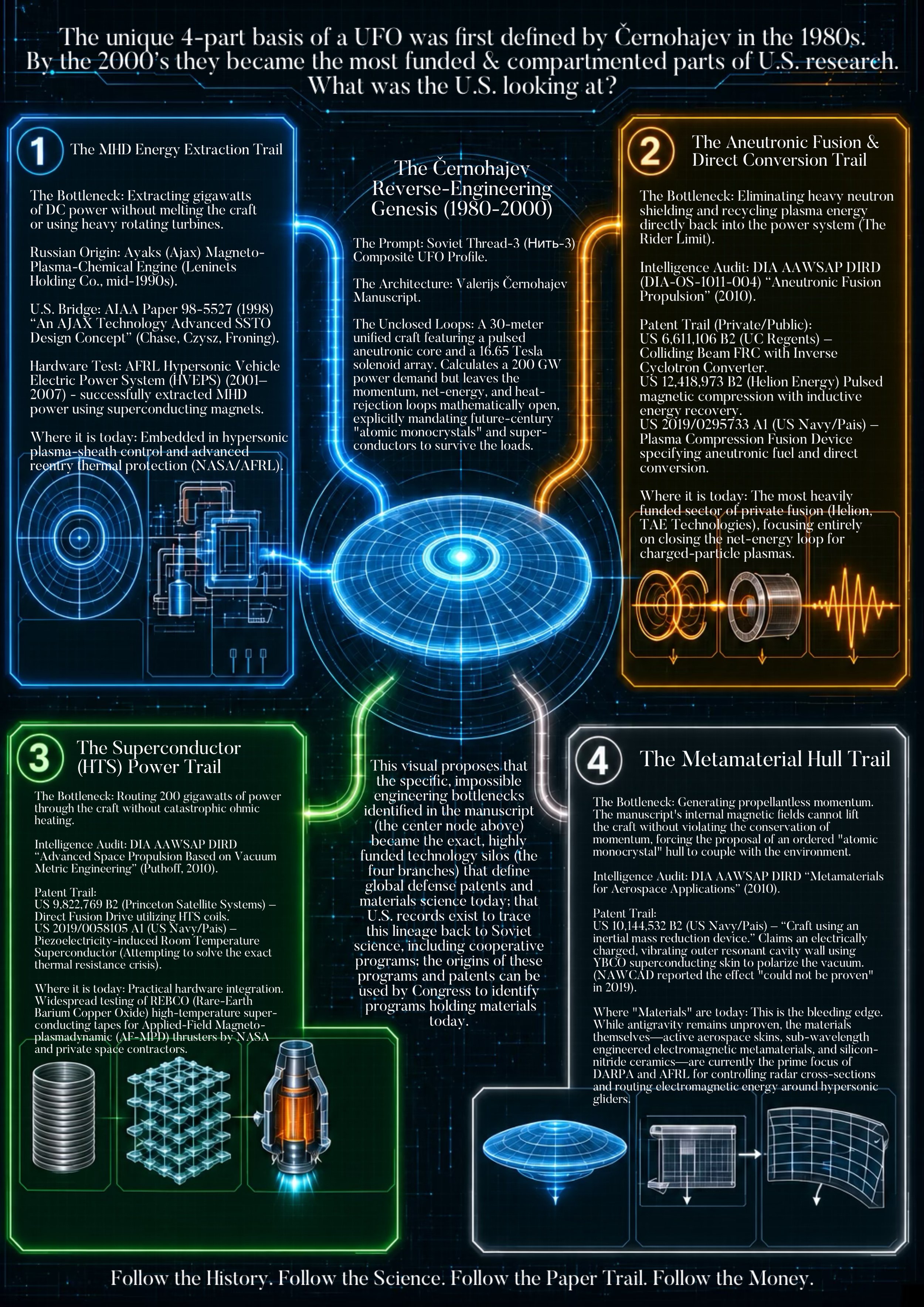
In the late 1980s, Soviet analysts were handed intelligence reports of craft that hovered silently, accelerated without sonic booms, and threw off heavy electromagnetic interference. They worked backward from those observations to the physics. Conventional aerodynamics could not account for the behavior, and their analysis arrived at four required components:
An aneutronic fusion core, to supply power without the mass of radiation shielding.
Magnetohydrodynamic (MHD) power extraction, to draw direct current from plasma with no rotating turbines.
Superconductors, to carry gigawatt-class current without resistive heating.
Metamaterial hull surfaces, to shape electromagnetic fields for propellantless lift.
That combination appears in no earlier public or military record. As the Soviet Union dissolved in the 1990s, the theory and the MHD mathematics reached the West. U.S. programs then took up the individual components separately, each inside its own classified compartment. Congress can reassemble the picture by subpoenaing those programs. Three stand out.
1. Air Force Research Laboratory: HVEPS
A craft with this architecture must produce gigawatt-class direct current and then shed the waste heat. The Soviet answer was MHD extraction from a high-speed flow. In the 1990s, U.S. researchers reconstructed the Russian "Ayaks" concept. By the early 2000s, AFRL moved it into hardware testing under the Hypersonic Vehicle Electric Power System (HVEPS) program and extracted power using a superconducting magnet. Public testing wound down around 2007. Congress should demand the program's origin documents and trace where the funding and the research went afterward. If the work continued, the money will show it.
2. Defense Intelligence Agency: AAWSAP
Standard fusion releases neutrons, and shielding against them makes a flight vehicle too heavy. Aneutronic fuels release charged particles instead, but no one has demonstrated net energy from them. The DIA's Advanced Aerospace Weapon System Applications Program (AAWSAP) ran from 2008 into the early 2010s and commissioned Defense Intelligence Reference Documents on subjects that map directly onto the Soviet list, among them aneutronic fusion propulsion and metamaterials for aerospace applications. Congress should subpoena the contract deliverables, test data, and internal correspondence from the DIA and its contractors. The answer will say whether the agency judged the net-energy problem solved or still decades out.
3. Department of the Navy: the Pais patents
Magnetic forces inside a closed system cannot lift it. Lift without exhaust requires coupling to something outside the system, and the Soviet design pointed to engineered materials acting on the quantum vacuum. Between 2015 and 2019, Dr. Salvatore Pais filed patents on behalf of the Secretary of the Navy covering a piezoelectricity-induced room-temperature superconductor and a craft with an electrically charged, vibrating resonant-cavity hull meant to reduce inertial mass. Congress should obtain the full USPTO file wrappers and the Naval Air Warfare Center test data, and question the technical officials who attested to the filings. A military service put on record that it had the materials and the physics for propellantless flight, and the basis for that statement belongs in the public record.
The Soviet design was drawn in the 1980s, and U.S. programs have worked on its parts for thirty years. Congress should audit the money spent on MHD extraction, aneutronic fusion, and high-temperature superconductivity.
Congressional hours spent on secondhand testimony about interdimensional entities, Vatican cover-ups, and hidden slush funds will end where earlier hearings ended, with claims no one can prove and a blanket Pentagon denial. The Navy's own paper trail can be checked. Subpoena the Naval Air Warfare Center test data, the funding records for the Pais work, and the officials who attested that the inventions were operable. Then put the question to the Navy directly: did the military build prototypes of this technology, or did it use the patent system to mislead foreign adversaries?
